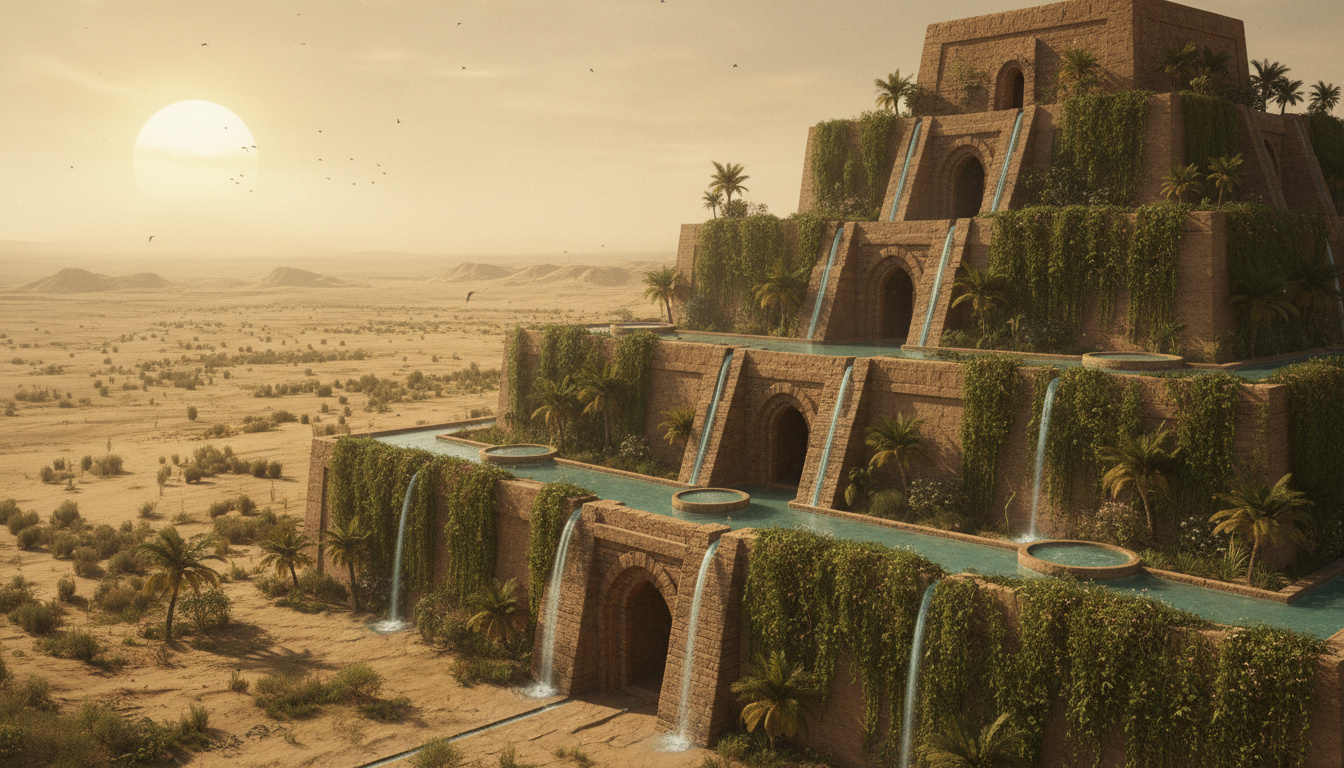
The Hanging Gardens of Babylon remain one of history’s most captivating enigmas. Unlike the Pyramids of Giza or the Temple of Artemis, whose stones still testify to their existence, these legendary terraces have left no definitive archaeological trace. Ancient writers described a verdant mountain rising from the Mesopotamian flatlands, irrigated by an ingenious hydraulic system that defied the arid climate. Yet modern excavations in Iraq have failed to locate their foundations, fueling a debate that spans centuries. The Seven Wonders of the Ancient World lists the gardens among humanity’s greatest achievements, though their physical reality continues to elude researchers.
Defining Characteristics
The classical sources attribute several remarkable features to the gardens:
- Elevated Construction: Terraces rising 20-80 feet above ground level, supported by baked brick arches and sealed with lead and asphalt to prevent leakage
- Irrigation Engineering: A chain-pump system lifting water from the Euphrates River to sustain trees and flowers in the upper levels
- Botanical Diversity: Cultivation of species from across the empire, creating a microclimate that simulated mountainous regions
- Location Uncertainty: Traditional placement in Babylon conflicts with emerging evidence pointing toward Nineveh
Historical Insights
The uncertainty surrounding the gardens extends beyond mere location. Recent scholarship suggests we may have been looking in the wrong place entirely. Dr. Stephanie Dalley’s hypothesis places the gardens not in Babylon but in Nineveh, constructed by the Assyrian king Sennacherib rather than the Babylonian ruler Nebuchadnezzar. This theory rests on reinterpretations of cuneiform texts and architectural comparisons with Assyrian aqueducts found at Jerwan. Unlike other ancient wonders that left indelible marks on the landscape, the gardens’ ephemeral nature—built from wood, mud brick, and vegetation—may explain their disappearance. Historical accounts describe the structure as a ”wonder for all peoples,” yet no contemporary Babylonian text corroborates its existence, a striking absence for a project of such magnitude.
Comparative Evidence
| Theory | Proposed Location | Key Evidence | Challenges |
|---|---|---|---|
| Traditional | Southern Palace, Babylon | Greek and Roman literary accounts | No archaeological remains; no contemporary Babylonian records |
| Nineveh Hypothesis | Palace of Sennacherib, Nineveh | Aqueduct inscriptions; palace descriptions matching garden features | Requires reinterpretation of classical topographies |
| Symbolic Interpretation | Various | Ancient Near Eastern literary motifs of paradise gardens | Does not account for specific architectural descriptions |
Architectural Descriptions
Ancient accounts paint a picture of engineering brilliance. Diodorus Siculus described mountain-like terraces rising in tiers, while Strabo mentioned screw pumps raising water from the Euphrates. The gardens supposedly featured trees and flowers from across the empire, creating a microclimate that astonished visitors. If they existed in Babylon, they would have required massive retaining walls and a chain-pump system unprecedented in the ancient world. Archaeological investigations suggest such hydraulic technology existed in Assyria but remains unattested in Babylon. The structure allegedly built by Nebuchadnezzar for his wife Amytis—homesick for the mountains of Media—would have represented a political statement of botanical mastery over nature.
Chronological Investigation
- : Traditional construction date under Nebuchadnezzar II
- : Berossus writes the earliest surviving description, establishing the Babylon connection
- : Historian Diodorus Siculus provides detailed architectural accounts
- : German archaeologist Robert Koldewey excavates Babylon’s Southern Palace
- : Dalley publishes initial Nineveh hypothesis based on cuneiform reinterpretation
- : Archival research at the British Museum supports Assyrian provenance
Evidentiary Challenges
Separating ancient testimony from archaeological reality requires caution. No ancient Babylonian administrative text, economic record, or royal inscription mentions the gardens, which is significant for a project requiring massive labor and materials. The Greek and Roman sources writing centuries later may have conflated Babylon with Nineveh, or mythologized royal landscaping projects into supernatural feats. Recent scholarship emphasizes that ancient historians often prioritized narrative coherence over geographical precision when describing the East.
Scholarly Assessment
The archaeological silence speaks volumes. Robert Koldewey’s excavation of Babylon’s Southern Palace revealed the ”Throne Room” and vaulted structures, but no elevated gardens. Meanwhile, Sennacherib’s palace at Nineveh bore inscriptions boasting of a ”wonder for all peoples,” accompanied by aqueduct remnants capable of sustaining elaborate botanical displays. This evidence shift suggests the gardens were real, but attributed to the wrong civilization through centuries of transmission errors among Mesopotamian civilizations. Modern analysis indicates the gardens likely existed as described, but as an Assyrian, not Babylonian, achievement.
Ancient Testimonies
The approach to the garden sloped like a hillside, and several parts of the structure rose from one another, resembling steps; and since the walls were supported by columns, the entire pressure rested upon the columns.
— Diodorus Siculus, Bibliotheca historica, 1st century BCE
In this palace he erected very high walks, supported by stone pillars; and by planting what was called a pensile paradise, and replenishing it with all sorts of large trees, he rendered the prospect an exact resemblance of a mountainous country.
— Quintus Curtius Rufus, Histories of Alexander the Great, 1st century CE
Ancient sources consistently emphasize the artificial mountain aspect and hydraulic mechanisms, details that align with known Assyrian engineering capabilities rather than Babylonian architectural traditions.
Summary
The Hanging Gardens represent archaeology’s most elegant mystery—perhaps a vanished marvel of Assyrian engineering misremembered as Babylonian, or perhaps a poetic exaggeration that solidified into historical fact. While the stones remain silent, the search continues beneath the Iraqi soil, reminding us that ancient history often preserves its greatest secrets in the gaps between texts and ruins.
Frequently Asked Questions
Did the Hanging Gardens actually exist?
Probably, but likely not in Babylon. Evidence points toward Nineveh as the actual location, constructed by Assyrian rather than Babylonian engineers during the 7th century BCE.
Why haven’t archaeologists found them?
If located in Babylon, erosion and continuous occupation may have erased traces. Alternatively, the Nineveh theory suggests we’ve excavated the wrong site entirely; Nineveh’s remains lie beneath modern Mosul, where political conflict has limited archaeological access.
How were the gardens watered?
Ancient descriptions mention screw pumps and aqueducts carrying water from the Euphrates or Tigris rivers, requiring remarkable hydraulic engineering involving chained buckets and mechanical lifting devices.
Who built them?
Traditional accounts credit Nebuchadnezzar II for his wife Amytis, but modern scholarship increasingly points to Sennacherib of Assyria, who constructed elaborate irrigation systems at Nineveh around 700 BCE.
Relaterade artiklar










Fredrik Lund är chefredaktör på Nyhetsbordet och ansvarar för redaktionell policy, rättelser och publiceringsbeslut.